Further development in Substack
Why do emotions strike before we can put words to them? Why do our reactions sometimes feel older than our thoughts?
How We Think explores the hidden machinery of the mind—not just the patterns we fall into, but the deeper process that creates those patterns in the first place. While most writing on thinking focuses on behavior—the shortcuts, biases, and habits we can observe from the outside—this publication goes underneath all that, into the neural computations that turn experience into categories, abstractions, and beliefs.
By understanding how the brain actually generates patterns—numerically, automatically, and often invisibly—we gain a clearer view of why we make the choices we do, why our intuitions feel so certain, and why our minds sometimes trap us in loops we never intended. Each essay connects this internal mechanism to everyday life, offering a way to see your own thinking with more clarity, more precision, and more freedom.
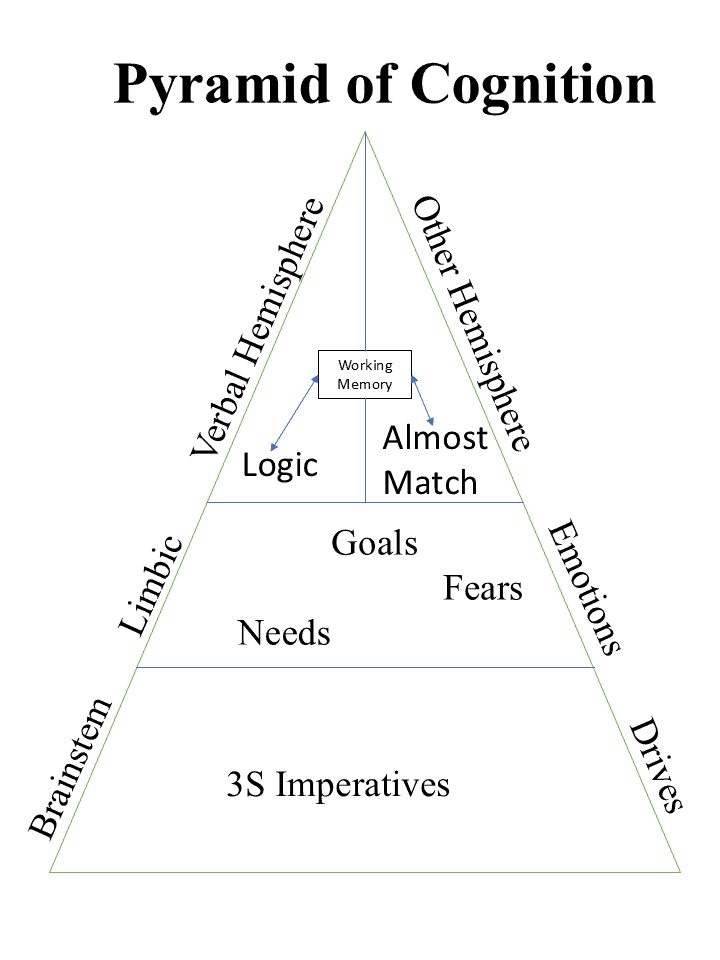
The hidden architecture of the mind comes into focus: ancient neural pathways, hemispheric specialization, and the brain’s pattern‑building machinery shaping every moment of awareness. Drawing on neural thresholds, all‑or‑none signaling, and Hebbian learning, How We Think reveals how the brain constructs meaning long before we consciously “decide” anything.
The right hemisphere delivers fast, emotional assessments; the left offers verbal logic. In the prefrontal cortex, these streams meet, giving us the power to choose responses that serve our goals rather than our impulses. This work traces the journey from raw sensation to conscious judgment, showing how the pyramid of cognition shapes the structure of thought—and how understanding that structure can change the way we live.